
Why consistent tracking matters
When you start OTC topical minoxidil, it can be tempting to inspect your hair every morning. But a bathroom mirror is not a controlled comparison. Lighting, hair length, part placement, and styling can make the same scalp look noticeably different from one day to the next.
A simple tracking system can help you document changes without turning every loose hair into a verdict. The goal is not to prove that treatment is working. It is to create useful records while following your product’s Drug Facts and knowing when to contact a healthcare professional.
Start with the right expectations
OTC topical minoxidil is intended for specific patterns of scalp hair thinning described on its label. It is not appropriate for every cause of hair loss, and results vary. Some people will not experience regrowth.
Use only a product labeled for your sex and follow its specific directions. US products differ in concentration, formulation, application frequency, and the time frame for evaluating results. Do not assume that directions for one foam or solution apply to another.
Before starting, seek professional advice if your hair loss is sudden or patchy, you do not know its cause, or your situation does not match the label. Do not use it on a red, inflamed, infected, irritated, or painful scalp. Ask a doctor before use if you have heart disease.
Prescription oral minoxidil is different from OTC topical minoxidil. Oral treatment requires clinician oversight; topical tracking advice is not a reason to start tablets, change a prescription, or swallow a topical product.
Build a useful baseline
Take your first set of photographs before starting, if possible. If you have already begun, start documenting now and record that date honestly. There is no need to recreate a “before” picture from memory.
Include a short baseline note:
- The product’s concentration and whether it is foam or solution.
- The sex-specific labeling and directed application schedule.
- Your start date, or your best estimate if uncertain.
- Your current hair length, haircut, and color.
- Any scalp symptoms already present.
Keep the packaging or a clear photograph of the Drug Facts. That makes it easier to check instructions and show a pharmacist or clinician exactly what you are using.
Make your photographs comparable
Keep the setup repeatable
Choose one indoor location with steady lighting. A fixed lamp is usually easier to reproduce than sunlight through a window. Avoid comparing a brightly lit overhead photograph with a softly lit front-facing picture.
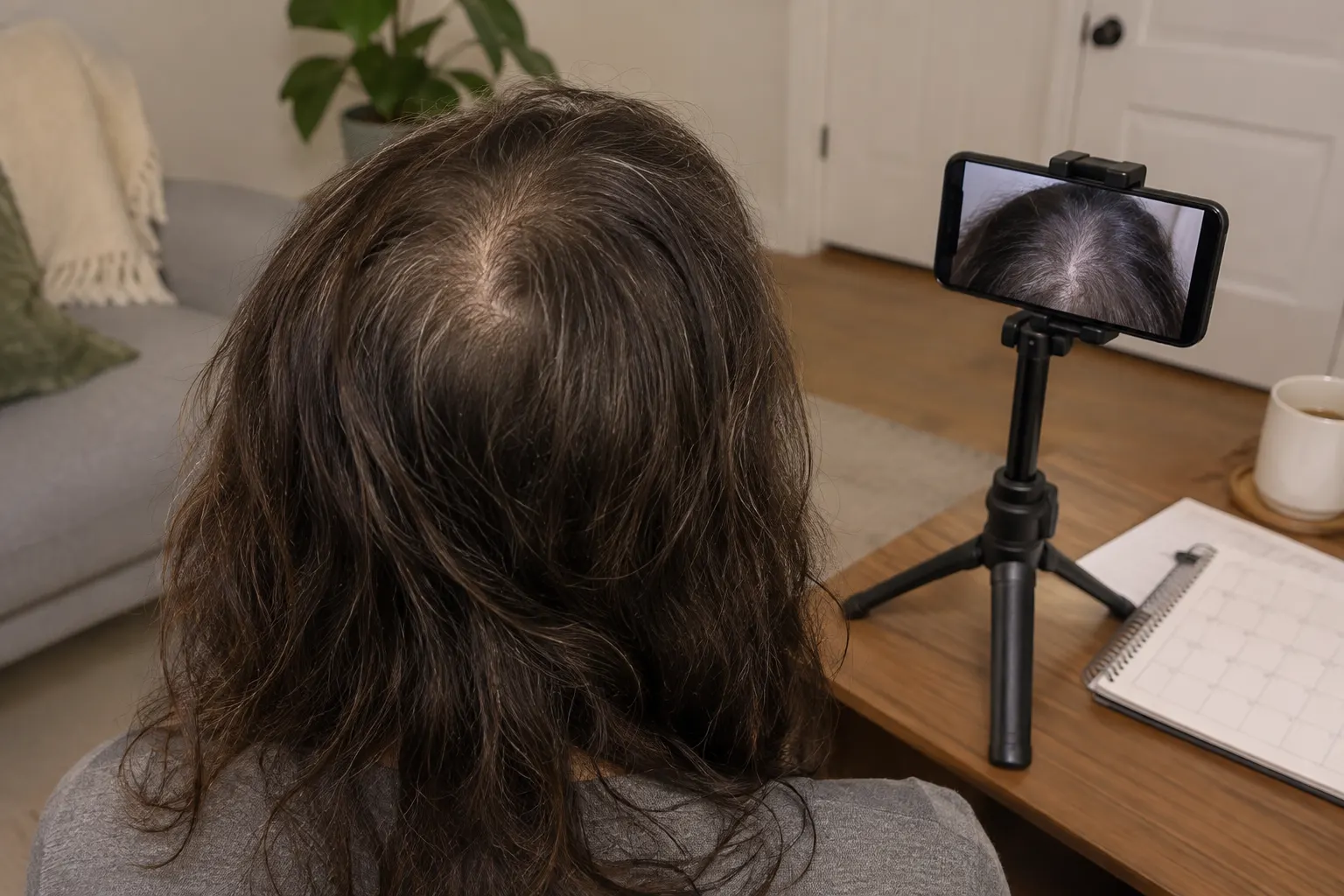
Use the same phone camera, distance, and angle each time. A phone stand or a marked spot on a shelf can help. If someone takes the pictures for you, ask them to follow the same setup.
Turn off beauty filters and avoid editing contrast or sharpness. Those changes can exaggerate differences in scalp visibility.
Keep your hair condition consistent
Photograph dry hair in a similar condition each time. Wet, oily, or heavily styled hair can clump and expose more scalp, even without a change in hair density.
For a cleaner comparison:
- Use the same part and similar combing direction.
- Avoid hair fibers, scalp concealers, and volumizing styling products.
- Note recent haircuts, coloring, or changes in hair length.
- Take pictures before application rather than while product is still wet.
Do not skip or rearrange treatment simply to get a photograph. Fit documentation around the labeled schedule.
Choose a few reliable views
Two or three repeatable views are more useful than a large collection of random angles. Depending on the area you are monitoring, these might include a top view, a crown view, and a view of your usual part.
Photographing an area does not mean minoxidil is labeled for use there. Apply only to the scalp area described in your product’s directions, not to the beard, eyebrows, or other body areas.
Use a calendar, not constant checking
A roughly monthly photo session is a practical documentation habit, not a medical dosing recommendation. Daily photographs often create more noise than clarity because hair positioning and lighting change so easily.
Store each session in a dated folder. Compare matching angles side by side, ideally at the same image size. Avoid repeatedly zooming into individual follicles or counting hairs from phone pictures; ordinary images cannot reliably measure those details.
Set a separate reminder for the evaluation point specified on your label. Some products direct users to stop and ask a doctor if there is no regrowth after four months; certain women’s 5% foam labels specify six months. Follow your actual package rather than a generic internet timeline.
Keep notes short and useful
A tracking log should take minutes, not become another daily obligation. Record information that could explain a confusing comparison or help a healthcare professional assess your experience.
Useful entries include:
- Missed applications or longer interruptions.
- Changes in formulation or other scalp products.
- Itching, redness, irritation, or unwanted facial hair.
- Haircuts, coloring, or use of cosmetic concealers.
- Questions to bring to a pharmacist or clinician.
If you miss a dose, follow the package instructions. Do not double up or apply extra to compensate. Using more than directed or applying more often will not improve results and may increase the risk of side effects.
Do not treat shedding or symptoms as proof
Loose hairs in the shower are not a reliable measure of treatment success. Wash frequency, brushing, and hair length can affect how much shedding you notice. Increased shedding is not proof that minoxidil is working, and photographs cannot establish why hair is falling out.
Follow any shedding guidance in your package leaflet. Ask a healthcare professional about persistent or concerning shedding, particularly if it is sudden, patchy, or accompanied by scalp symptoms.
Stop use and ask a doctor if you develop chest pain, rapid heartbeat, faintness, dizziness, sudden unexplained weight gain, swelling of the hands or feet, scalp irritation or redness, or unwanted facial hair. Seek urgent medical care for severe symptoms such as chest pain or fainting. Do not wait for your next photo session.
Use your records to support decisions
At the label’s evaluation point, review your photographs, notes, and directions together. If there is no regrowth by the stated deadline, follow the instruction to stop and ask a doctor rather than extending treatment on your own.
If regrowth occurs, continued use is needed to maintain it; stopping generally leads to loss of the newly regrown hair over time. A clinician can help discuss concerns or uncertainty about continued treatment.
Good tracking is intentionally simple: consistent photographs, brief notes, and attention to the label. It supports a clearer conversation about your experience without promising an outcome that no photograph or calendar can guarantee.